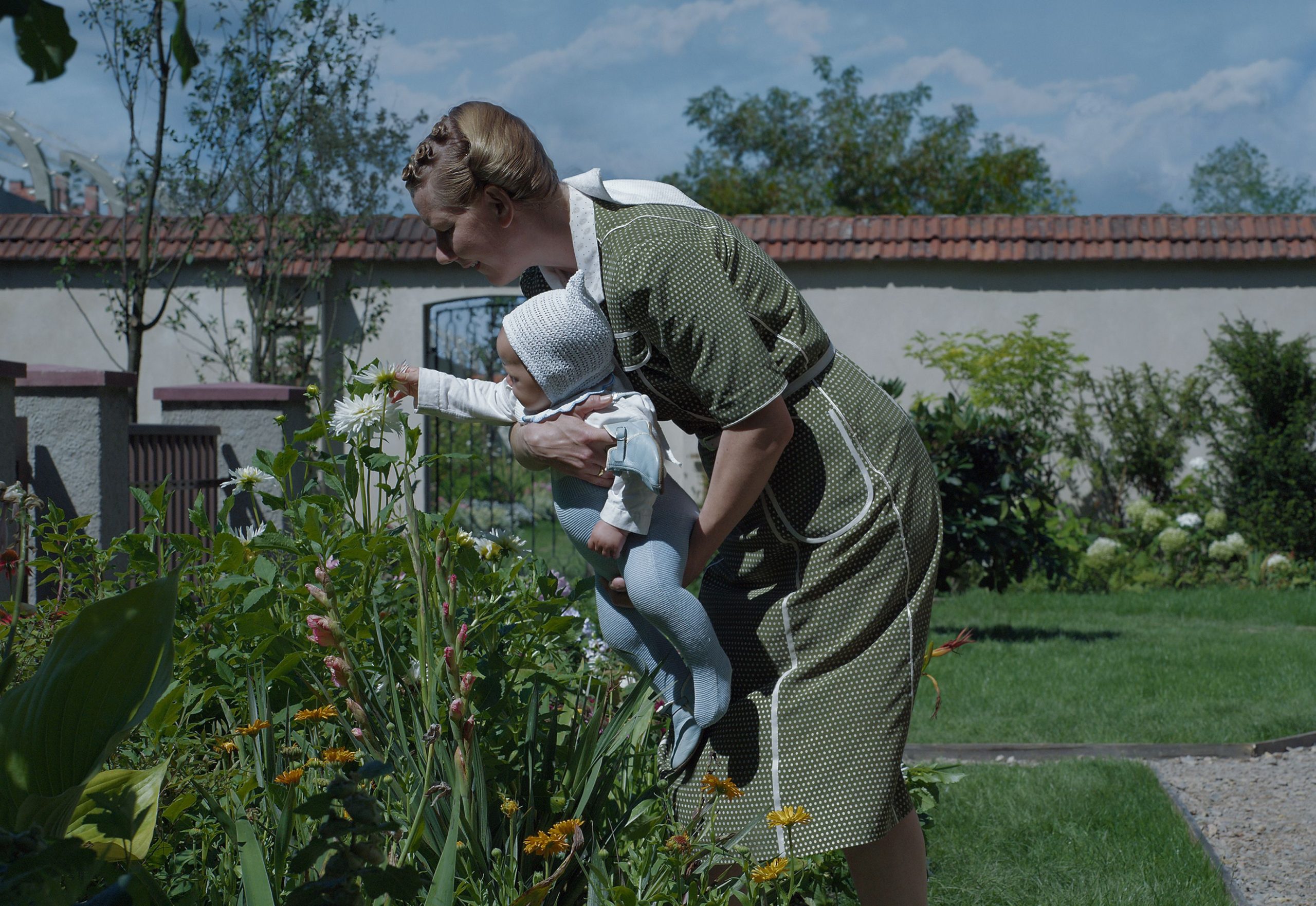

There is a wall in The Zone of Interest, and for most of the film’s runtime, it is the only thing separating a burgeoning garden, with roses climbing a trellis, children splashing in a paddling pool, a mother from Auschwitz, tending her dahlias. You are unable to see what lies beyond it.
Jonathan Glazer’s war drama intuits that the obscenest image imaginable is the one he refuses to show you. The horror stays exactly where it belongs, on the other side of a hedge, rendered almost entirely through sound.
That decision is the entire film, and it is formally audacious. Glazer, adapting Martin Amis’s novel of the same name only in the loosest sense, strips away plot in favour of observation.
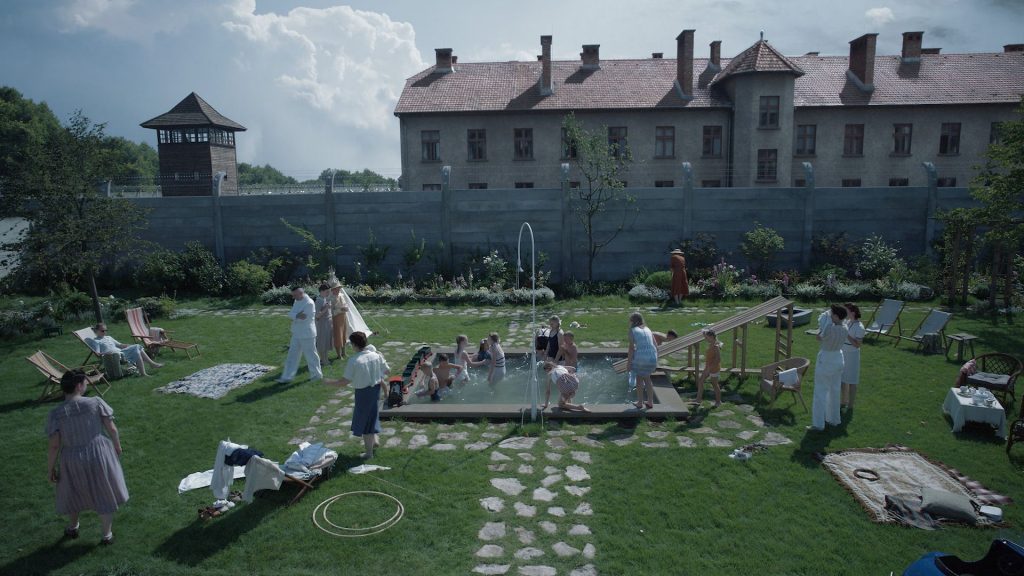
Christian Friedel portrays Rudolf Höss, commandant of Auschwitz, with a chilling domestic ordinariness, as we watch his family go about the business of living well. In his house, there are birthday parties, boat trips, a newfangled coat modelled in front of a mirror.
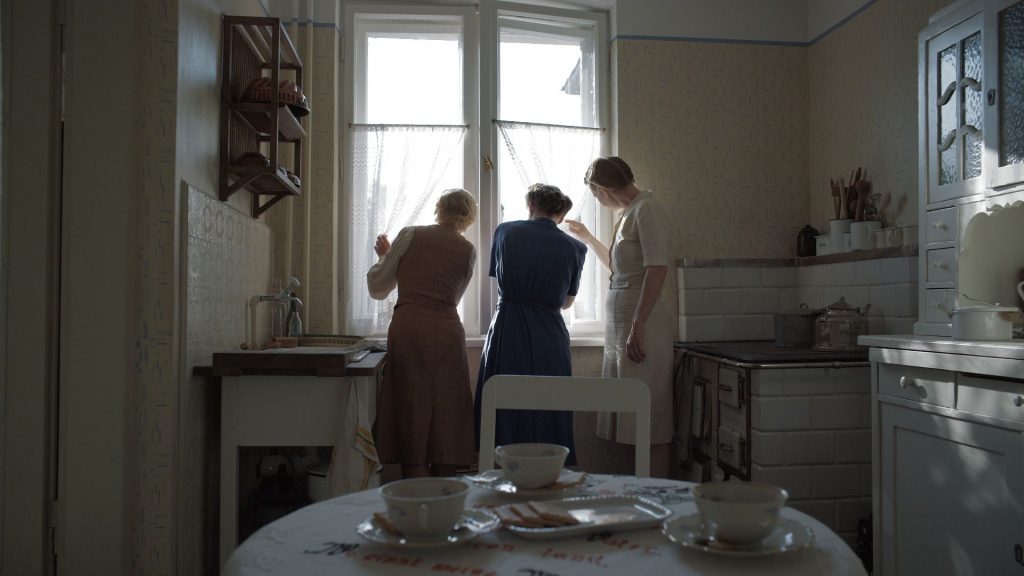
Sandra Hüller, as his wife Hedwig Höss, presides over the household with the brisk satisfaction of a woman who has built her dream life and intends to defend it, at any cost, regardless of what is happening only a few hundred meters from her kitchen window.
The award-winning actress famous for her role as Sandra Voyterin Anatomy of a Fall, gives a performance built almost entirely out of small, unsettling tells. There’s the tilt of her chin when a servant displeases her, and hubris that follows her as she shows a visiting friend her garden. ‘The paradise’, as she calls it, that she and her husband have forged.
The movie’s brilliance lies in what it doesn’t show the audience. Glazer and cinematographer Łukasz Żal shoot the domestic scenes with a flat, almost clinical detachment: fixed cameras, natural light, compositions that resemble surveillance footage more than cinema. There is no score to guide your feelings, no lingering close-ups to tell you how to react to a devastating line of dialogue. The camera passively observes, indifferent to what it’s actually recording.
The sound design does the work the images refuse to do. Mica Levi’s score, arrives like a wound, dissonant and brief. It bookends the film rather accompanies it. The true force at work here is Johnnie Burn’s sound design: a constant, low-grade industrial hum that never fully leaves the mix. Distant shouting. The metallic clang of machinery. A furnace that never seems to stop working. It sits beneath every scene of pastoral domesticity like tinnitus. And once you notice it, you cannot stop listening to it, which precisely is the point. That is exactly the type of horror the film is actually interested in: the human capacity to build a life so thoroughly walled off from suffering that the suffering becomes its ambient noise.
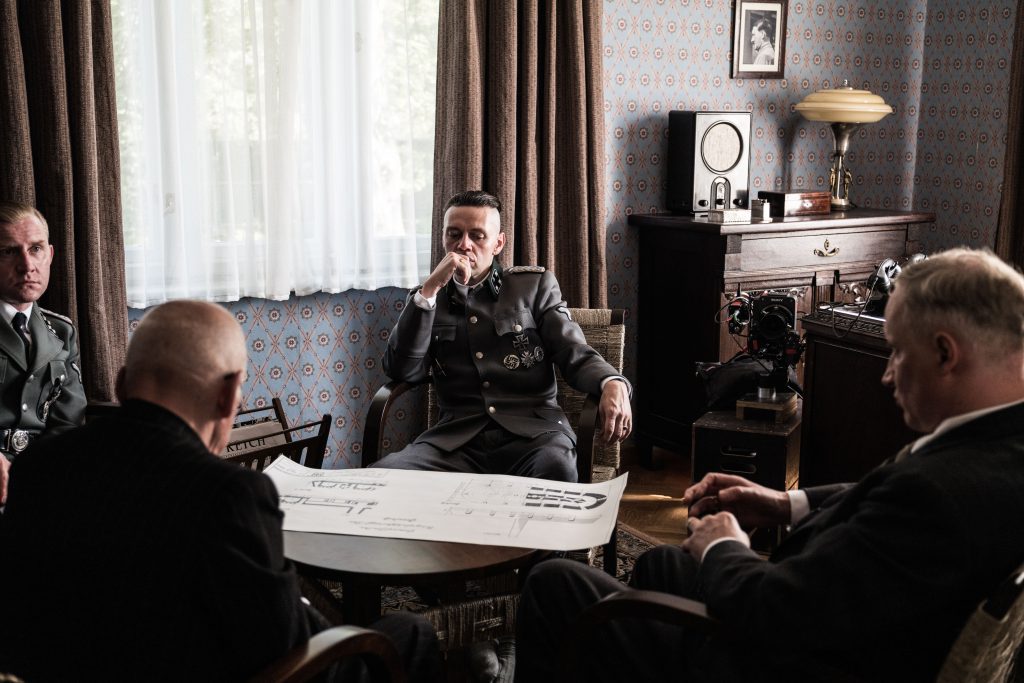
Christian Friedel’s character, Rudolf Höss, is a portrait of bureaucratic competence curdled into something monstrous. His most chilling scene involves nothing more than a man discussing crematorium logistics with the unnerving opaqueness best described as someone reviewing a spreadsheet.
The filmmaker, Jonathan Glazer, has spoken up about wanting to strip away the ‘villain’ iconography that decades of Holocaust cinema have built up around Nazism: the black leather, the operatic cruelty, and replace it with something closer to the historical truth – that evil, at this scale, was built on bureaucracy, cutthroat promotions, and all the people who simply decline to look over the wall.
This film cannot be characterised as a laid-back watch, though this has little to do with what you might expect from a Holocaust film. There is almost nothing here in the way of conventional violence. The unease is slower and more insidious, building on you slowly, the way the hum in the sound draws you in, accumulating until you realise you have been sitting in dread for two hours without a single scene designed to frighten you.
Some viewers have found this approach cerebral to the point of coldness, which is a valid response to a film that, by design, withholds catharsis. Glazer isn’t interested in offering the emotional release of a villain’s comeuppance or a victim’s rescue. His target is the psychological mechanism of denial, which by extension is the audience’s own wall.
That ambition occasionally outpaces the film’s patience for narrative. This is a movie built more like an installation than a story, one that invites you to sit with repetition and accumulation rather than incident. Its formal rigour is genuinely rare in contemporary cinema. However, in its concluding scenes, an audacious structural swerve reframes everything that comes before it and calls into question the act of watching itself.
The Zone of Interest won the Grand Prix at Cannes and the Oscar for Best International Feature, both prizes that feel earned, and that testify to a film that trusts its audience to sit with discomfort rather than be soothed by it.
It is less a war film than a film about denial, a cinematic study of how ordinary people build gardens of Eden next to hell. Decades from now, when other Holocaust films have faded into a kind of insipid repetitiveness, this film is likely to continue to unsettle, and the reason has everything to do with what it compels you to heed.
UK audiences can stream The Zone of Interest on Amazon Prime and Apple TV.