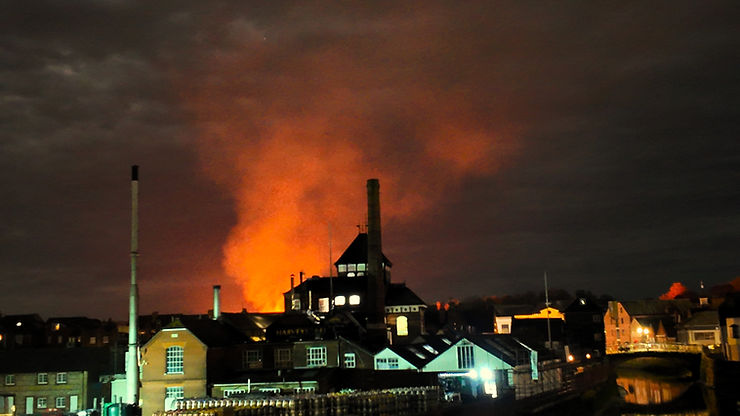

The air is thick with the smell of gunpowder and burning paraffin. It’s hard to breathe. The narrow streets are packed with onlookers mesmerised by the approaching fire. An orange halo looms over the small market town of Lewes as, one night a year, it erupts into a ferocious festival of flame and defiance.
This is Lewes Bonfire.
Lewes is a picturesque town nestled on the River Ouse in East Sussex. It’s quaint, quiet, and quintessentially middle class. It’s all bric-à-brac and bungaroosh, Barbour jackets and cockapoos… but not tonight. The rye chuckles and Range Rovers are replaced by the chaotic boom of fireworks and bangers (locally named rookies), which echo around every narrow alleyway and cosy cul-de-sac.

I had arranged to meet the Haverly Family during the bonfire. Adam, Sam and their two daughters. Adam is a carpenter by trade, but one night a year, he drops his handsaw and picks up a flaming torch. Dressed as rebellious French peasants. He, his wife and two daughters march down the streets of Lewes with a 20-foot Keir Starmer tableau behind them, heading towards the fire site where it will meet its fiery crescendo.
Sam had been born into Lewes bonfire. Even at a few weeks old, her Dad carried her down the Cliffe High Street in one arm, a flaming torch in the other.
Sam’s pride in this heritage was clear to see, “I’ve been going to (Lewes) bonfire for 40 years.
“I was a part of Borough from two weeks old until I was about 17. Then I had about three or four years off to get drunk with my friends and enjoy the ‘fun-ness’, then I rejoined at about 21 and transitioned to Cliffe.”
The Haverly’s are now proud members of one of the oldest societies: the Cliffe Society. This wasn’t always the case. They were originally part of the other oldest society: Lewes Borough.
During Sam’s hiatus, her sister Shannon fell in love with Tim, a boy from Cliffe Society. Creating a sort of paraffin-fueled, pyro- Romeo & Juliet Story.
I liked Adam and his family. They had a calm nature, which is not easy to achieve when someone is holding a slowly unravelling flaming torch inches from your eyebrows. He stood wearing a beige Buccaneers hat and a long navy-blue dress coat. His Cliffe members’ badge hung proudly next to his brass buttons. He reminded me of a revolting Frenchman (I am speaking of the Revolution, not mindless xenophobia).
Tableaus are a big part of the bonfire tradition. Each society constructs its own in complete secrecy, even from its own society members. They depict public figures who have generated some element of hatred. In the past, they have had Putin in a mankini, David Cameron atop a pig, and one year, the witch doctor of the coronavirus.

This does come with controversies, especially when they are of political and religious figures. Sam told me, “There’s a whole thing on the news now, about how we shouldn’t be ‘burning’ politicians anymore.
“But if they’re doing something wrong. It’s the one time in a whole year to put someone on the stage and be like, ‘we don’t agree with this?’”
Silence fell amongst the chaos at the war memorial. A rare glimpse of calm, as each society took it in turns to pay their respects to the fallen. Remembrance holds the utmost respect at Lewes Bonfire. 17 flaming crosses cruise through the streets of Lewes to remember the 17 Protestant martyrs of 1555, who were burnt after they refused to denounce their faith.
During the two-minute silence, an anonymous voice from the packed crowd shouted ‘oggy-oggy-oggy’ and was immediately reprimanded by everyone present.

Society tributes are a sacred ritual. Long-serving members are remembered by having their names in flame and carried down with the main procession. Adam and Sam told me of a Cliffe member this year who had a very special tribute at their fire site. “There was a guy this year who was put on the bonfire, called Dave.
“They had a fake scarecrow, in a jumper for him, on the side of the bonfire, and his ashes were inside. And people were walking around wearing badges that said: ‘My name is Dave’.”
From the 17 martyrs of 1555 to Dave in 2025, individuals’ efforts and commitment to their community are never forgotten. It doesn’t matter about the size of your wallet; it’s the size of your effort. Adam made this clear when he told me, “It doesn’t matter how much money you have behind you; it’s about how much you do. I wish all society were like that.”
Sam’s dad, who is almost 80 years old, has a very special request for his tribute. He wants to be put in a firework and explode over the crowd. “Not sure how much I like the idea of him raining down on us, but it’s what he wants,” Sam said, rolling her eyes. Adam interjected: “They are all bonfire mad!”
There is a unique tradition on the morning of the bonfire. Each society has a nominated ‘Arch Bishop and his Clergy men’. A member who dresses as a priest and sits down with the other archbishops to enjoy breakfast in full costume.
At the end of the procession, they stand on plinths, read a speech and declare their ‘enemy of the state’, who can be anything from Vladimir Putin, to a local councillor who isn’t doing enough about potholes. Adam told me, “When you are the archbishop, people are throwing rookies at you.”
Sam interjected, “ You’re standing there while thousands of people are purposely trying to hurt you, and all you have are safety goggles.”
The rookies are pretty ferocious. Adam told me he was hit by one this year. “I went out again at 11 pm for the last procession, and a rookie hit my chest and then just saw this blood come through my white shirt. I was like ‘ah great’.”
Adam laughed. He didn’t seem fazed that he had been hit with an explosive, but I guess that’s what the bonfire is about. I’m sure if he were hit by one on his weekly shop at Morrisons, his reaction would probably be a bit different.
I wondered if Adam and Sam ever felt worried for their two daughters in the procession.
Sam said, “I find it one of the safest things to do. Everyone has this idea that it’s full of young people getting p*ssed, throwing bangers at everyone, but it’s not. It’s very safe to be in the procession. Everyone has each other’s back.”
Lewes is steeped in history. Originally founded in 1067 by the 1st Earl of Surrey, William de Warenne, famed as the right-hand man of William the Conqueror. Following the Norman victory of the Battle of Hastings, he built Lewes Castle on a man-made mount, overlooking the two towns of Lewes and Cliffe. The dishevelled flint castle looms over the town like a constant guardian and reminder of Lewes’ rich history.

There’s a Sussex phrase. “WE WUN’T BE DRUV”. It’s Sussex dialect for we won’t be driven: Make up your own mind, don’t be led, don’t act against your will. Lewesians live by it like a mantra, and the bonfire is a perfect emblem of this.
Rebellious locals have stood defiant against numerous judges, police officers and magistrates over the centuries. During the riots of 1829, the Bonfire Boys threw an anti-bonfire magistrate into the River Ouse. This is commemorated every year by the Cliffe Society throwing a burning tar barrel over the Cliff High Street bridge and into the dark, slow-rushing depths of the cold river.
It’s clear to see that the WE WUNT BE DRUV spirit is alive and well. Lewes Bonfire is huge now. In 2024, an estimated 40,000 people descended into the small town to see the spectacle. Sussex Police and the local council implore people not to attend; they cancel trains and close off the roads. But tens of thousands of defiant revellers still flock to the event every year.
The bonfire boys, who were a ragtag group of bonfire enthusiasts, battled with the authorities for years to continue the tradition. By 1853, Bonfire boys feared their celebration would be closed down altogether and decided to form ‘Bonfire Societies’: Cliffe Society and Town (now Lewes Borough). There are now seven recognised societies, each with its own attire and motto: Cliffe, Lewes Borough, Nevill, Southover, Waterloo, South Street and Commercial Square.
The main takeaway from this event is defiance. The resilience against centuries of naysayers and authorities trying to close it down, but the bonfire rages on and will forever.
It’s not commercial. It’s not about the size of your back pocket.
Every day of the year, you may be the butcher, the baker, or even the candlestick maker. But on the 5th of November, you are a rebellious French peasant, an Archbishop, or even Jack Sparrow.
So dear reader, remain defiant and never be DRUV!