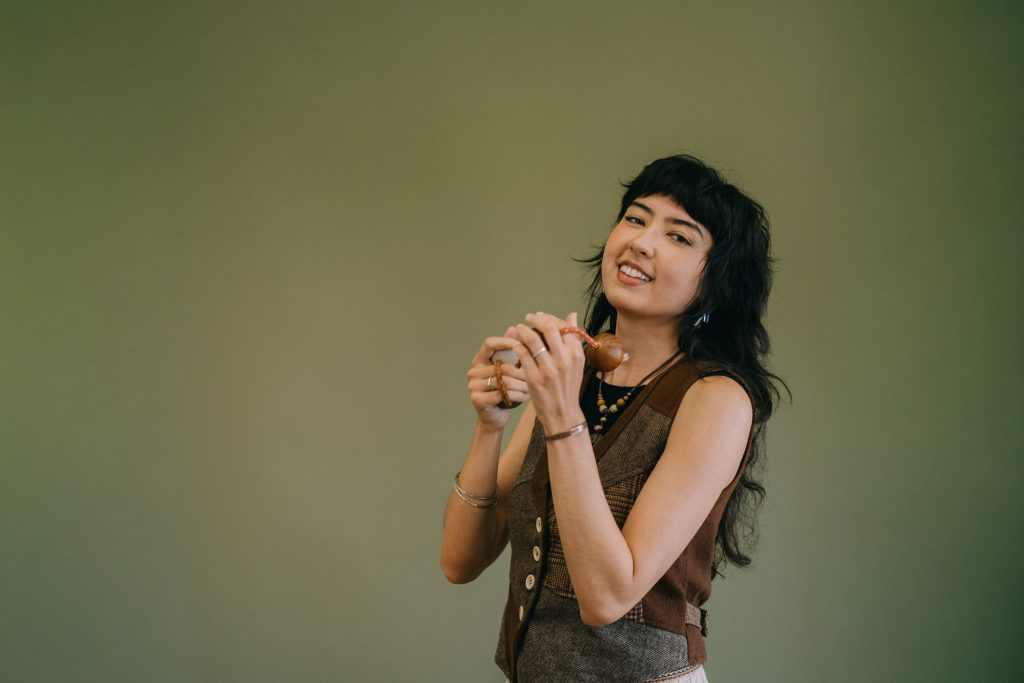

The world came to a standstill in 2020. The relationship between entertainers and audiences had no choice but to transition to digital platforms. As the lives of millions were disrupted by closures and the halt of face-to-face interactions, many acquired new skills and made the best of the situation. For Mari Merenda, curiosity was the key element in avoiding the feeling of being locked up during the pandemic. It ignited a sense of freedom and guided her, as if by fate, towards a musical instrument of West African origin.
Asalato, or Kashaka is a traditional West African percussion instrument consisting of two small hollow gourds or balls filled with seeds, beads, or pebbles, connected by a string. One ball is held in the hand while the other swings around it, creating both a shaking sound and a sharp clicking sound when the balls strike each other.
“In Brazil we are moved a lot by African roots, because of colonisation,” says Mari during our video call from Brazil. “We take a lot from African religions and culture,” she adds, while also noting the freedom of belief in Brazil that allows people to practice them.
Yet, what brought the attention of millions to her social media accounts was the mixture of soft vocals and meditative backgrounds.
Incidental or random events have a tendency to alter the course of your life. Which direction they might take you in is heavily luck-dependent. But when you have a friend by your side, the deck of fortune is more likely laid out in your favor.
The cue for Mari to learn about the Asalato and fall in love with it came through a friend who introduced her to a Cirque du Soleil performer who played it. As her graduation occurred right before the pandemic, and the aftermath that followed worsened the revenue model for up-and-coming talent, Mari took advantage of the time to learn more about instrumental techniques through social media videos. What transpired thereafter was her very first album, Crônica (2022), produced entirely in her bedroom. Having people request Asalato lessons was an unexpected bonus.
“I see playing Asalato as a form of meditation, because there is something about it that you always need to feel present to be able to play it. I began to study piano but never had the same kind of connection as with Asalato. There are a lot of things I learned with this instrument that I could apply to piano techniques. Sometimes, I believe that instruments choose us.”
Building on this idea, what next comes to mind is the diminishing number of university graduates seeking their way into the industry. Practicality has shifted music theory to the sidelines, and even Mari admits that networking is a big part of the journey to recognition.
“I was never good at networking. Social media played a big part in building connections,” she answers a question regarding advice for all aspiring students considering the music industry as a serious entrepreneurial venture. “I would definitely advise putting yourself out there, even if you feel like you are not ready yet. Social media allows you to build the necessary bridges you need as a music artist.”
As an example, it was only after a social media video with Sofia Addressore, another singer and songwriter from Brazil, went viral that fame followed Mari, when the New York City-based American musical DJ duo Sofi Tukker noticed their talent. “There is no way of feeling prepared; things happen all of a sudden. Same as with Asalato, there was no way to prepare myself for that. But every single thing you learn in life, kind of builds up to that moment,” Mari adds, further saying that true artists are always on the lookout to discover new projects.
Although she is an independent artist right now, speaking from her own experience, she notes that the best way to catch the attention of a well-known artist is to have strong self-awareness about what your creative work actually is. “The more you know about yourself and the other artist the more likely you are able to sell your creative work and connect with audiences.” Mari emphasises that comparison is the thief of joy and that thinking about the outcome impedes success.
Listeners respond most acutely to emotion. While social context matters in understanding what type of song should come next, the struggle to find belonging is a familiar pattern for artists like Mari.
“It is always about finding myself, but I always write from a way of liberating, expressing and understanding myself. It is easier to digest emotions if they are in a form of art.” Scenes of characters in stories inspired her first album, while her second album, Reverbero, released last year, focused entirely on how her music connects with other people. A third-person perspective takes priority for her. “It is never about love for me; it is always about human experiences.”
To maintain professional cohesion amid constant audience demand, a new album is in the works. With a release date set for the first quarter of 2027, Código which directly translates into English as Code is all about stopping to try and decode the world. Framed around the notion of decoding oneself, Mari confesses that this is the first time vulnerability has taken hold of her while working on this project.
Despite her heightened awareness of the inner thoughts exposed through her upcoming album, writing educational literature paves the way for a new generation of Asalato players. This November, a book release is underway.
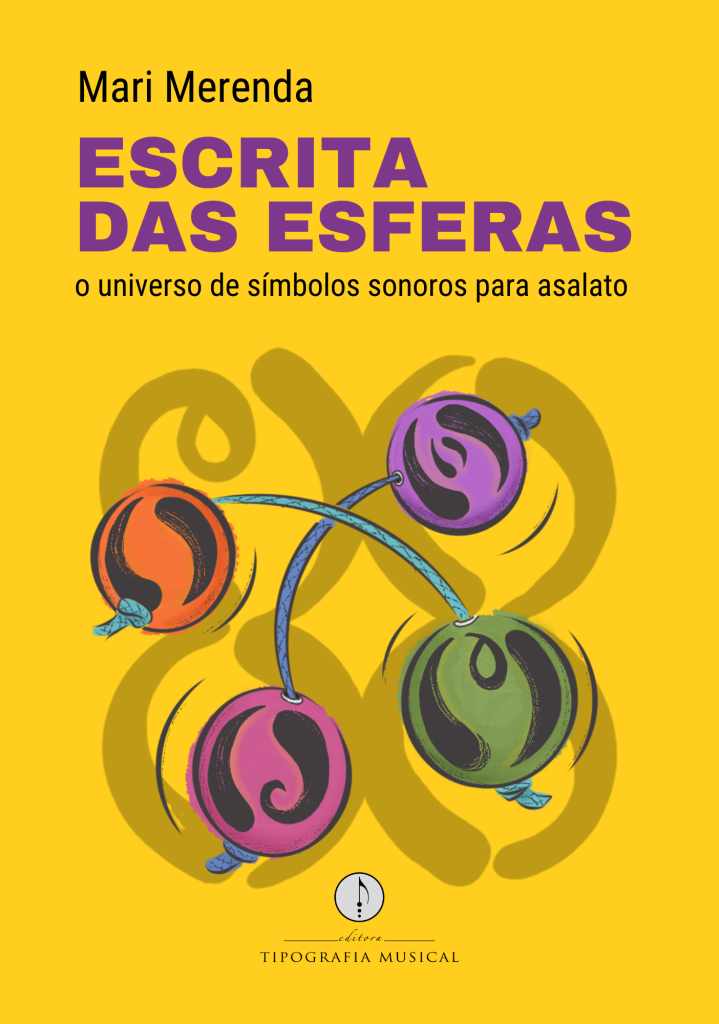
With so little literature available on this percussive instrument, Escrita Das Esferas features a bespoke musical notation system and instructions for mastering proper Asalato technique. “It was pretty hard using the common notation system, especially because a lot of my students aren’t musicians. I built symbols that symbolise the movement when playing Asalato.”
Sales of educational titles continue to rise, and the publishing industry in this sector has seen a spike of 4.4% this year. However, an added dimension to our discussion was the concept of the techno-feudalism of knowledge.
A recent investigation by 404 Media, a journalist-founded digital media company exploring how technology shapes the modern world, proposed the idea of paying a subscription for wisdom. After it was revealed that Amazon is bulk-buying rare books for its AI training facilities and later destroying them, our conversation shifted toward the music industry and the impact AI is making.
Mari is not afraid of AI, but she is concerned about the modern generation’s overreliance on it. While open to using it as a tool for basic studying and research, she recognises its limitations.
“I like to believe that in the near future we are going to feel fed up with everything that is AI. It steals from everything that already exists, but doesn’t have the power to create something out of nowhere. I am not afraid of AI because I am always creating.”
As a firm believer that AI causes people to lose the ability to write, read, and think critically, Mari confides that she has never used AI in the production of her albums.
“I think we are living in a historical moment. Things are cyclical. We have to believe that somehow, a day will come when we are just fed up with the aesthetics of it.”
Mari Merenda will perform at The Alphabet in Brighton on 14 October.