
Everybody knows Brighton is the UK’s gay capital. It has a country-wide reputation as a fun, free-loving place. What many people don’t know, however, is how it gained this label—and why it has stuck to this day.
With origins dating back to the 17th century, when Brighton shifted from a quiet fishing village to a garrison town for use in the war, it later became a holiday destination for high society when the supposed health benefits of seawater were popularised.
With the evolution of rail travel, journeys to and from London became easier. And, with the attraction of the burgeoning entertainment scene, theatres, the pier and the seafront, visitors flocked to Brighton and helped lay the foundations for this reputation. Oscar Wilde was one of many gay figures to live here.
The first gay venues appeared in the city around a century ago near St. James Street, although homosexuality wouldn’t be legalised for another 40 years.
The city has remained a hub for activity and activism in the LGBTQ+ community. But what continues to attract is it still the same as it once was. And what support is there for members of the community in Brighton that isn’t found elsewhere?
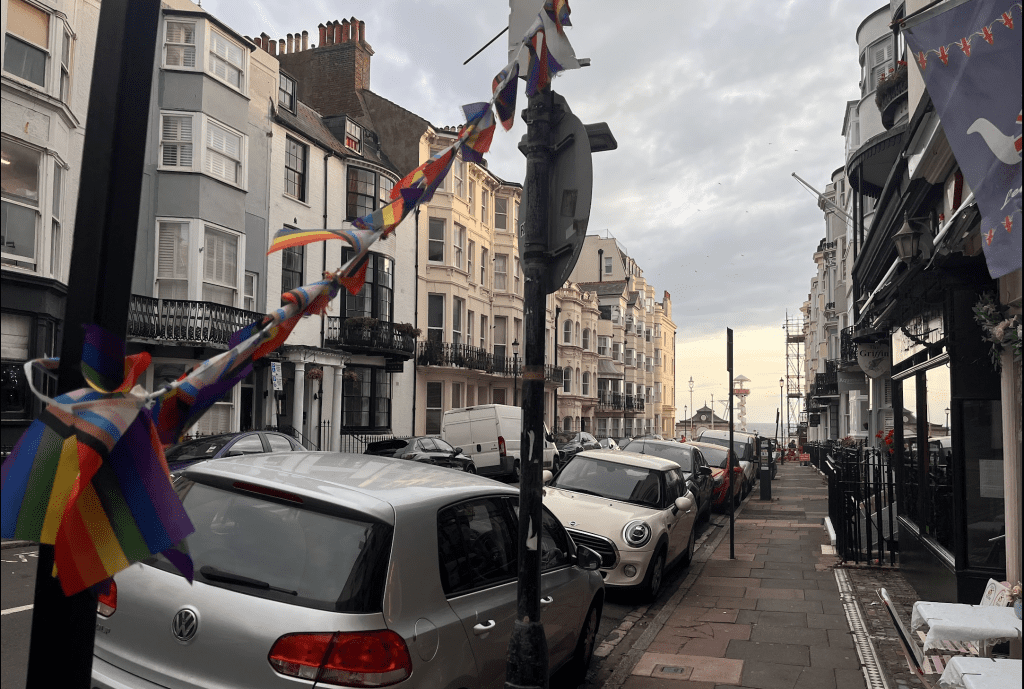
Walking through Brighton today, it’s easy to see what attracts people in the first place: the welcoming atmosphere, easy-going air, and the creative, bohemian nature of the city with its residents.
You don’t have to walk far in Brighton before you find a gay bar, pub, or at the very least an LGBTQ+ friendly venue. There’s a palpable sense of community for queer people, and the rainbow flags of the city aren’t torn down and stored away in a dingy back room for their next annual appearance. They stay up year-round as a constant feature.
Curious about how the landscape of the city has changed over the years, I got talking to Harry Pygar, who moved to the city in 1988 in order to come out and start over in a more accepting environment.
He explained that Brighton at that time possessed London’s vibrancy and allure, with a reputation for being openly queer and accepting of mavericks and outsiders, regardless of their skin color, gender, or sexuality.
When Harry moved to Brighton, life was much more hostile for queer people in the wake of Thatcherism, the Section 28 Law, and the AIDS epidemic.
Although comparatively a safer and more welcoming place than London, life was by no means free from persecution. The police were apathetic towards instances of hate crimes and the gay community were largely blamed for AIDS, even though they were by far the most affected.
Despite this, a sense of community was easy to find in Brighton, as there was a vibrant gay scene, with pubs, clubs, and events, as well as the Sussex AIDS Centre for support.
Harry even played his own small part in the community, owning a cafe which inadvertently became a hub in the queer community. Gay and drag club nights were advertised, and the Sussex AIDS Centre even held meetings there after closing time.
Without the internet as a source of information or connections, in some ways, the queer scene in Brighton was larger than it is now.
While the scene has evolved drastically, annual Pride marches have been a constant feature since its inception in 1991 as we know it today. Despite the insidious commercialisation over the years, the fundamental messages behind the parade remain the same.
Harry remembers a time of being apprehensive and fairly afraid when partaking in some of the first parades, telling me about how a Pride Day party on the beach was met with hostile crowds.
When asked about his feelings on Pride celebrations, he said: “I’m in two minds about Pride, I have become quite disenfranchised with it and how it’s no longer really about protest.
“I like how you can’t escape the rainbow flag in any part of the city. It’s very in your face.
“We’re here, we’re queer, we’re not going shopping.”
Still, the increasing commercialism and clear tokenism around Pride from international businesses leaves a sour taste in the mouths of many in the community.
With a 2021 national census suggesting that 1 in 10 residents of Brighton and Hove are LGBTQ+, what support network is there available?
In many cases, the existing help for the wider population does not apply or isn’t specialised or educated enough for helping LGBTQ+ people. To find out more about what support there is for members of the community in Brighton, I got talking to Rob Sainsbury, the chief executive officer of UK wide non-profit charity Switchboard, at the forefront of a continuing push for equality.
Starting 50 years ago as a gay helpline, Switchboard has since diversified, offering support to both young people and older members of the community by running breakfast clubs and educating care staff on LGBTQ+ specific support.
In what is clearly an uphill battle, Rob admitted there is a deficit in help available for members of the community.
“As a charity, we’re likely more trusted than the NHS amongst the LGBTQ+ community”, he said.
With charity’s LGBTQ+ focused health programmes, they frequently act as a middleman between members of the community and the health support they need. Intersex and transgender people are a particular focus of the charity, whose faith in the healthcare provider has been beaten down by consistently lacklustre treatment.
Rob had a few things to say about the attraction of Brighton:
“There’s a higher demographic of LGBTQ+ people compared to many other places, so it’s often seen as a place of safety.
“It’s also a liberal, left-leaning political space, making it more inclusive for everyone.”
These things combined made him believe Brighton to have a natural attraction to queer people.
Brighton, with its history of openness and acceptance, continues to be a symbol of optimism for those who feel like outsiders, misfits, or members of the LGBTQ+ community seeking a sense of community not found elsewhere.
Edited by Yan Sorochynskyi