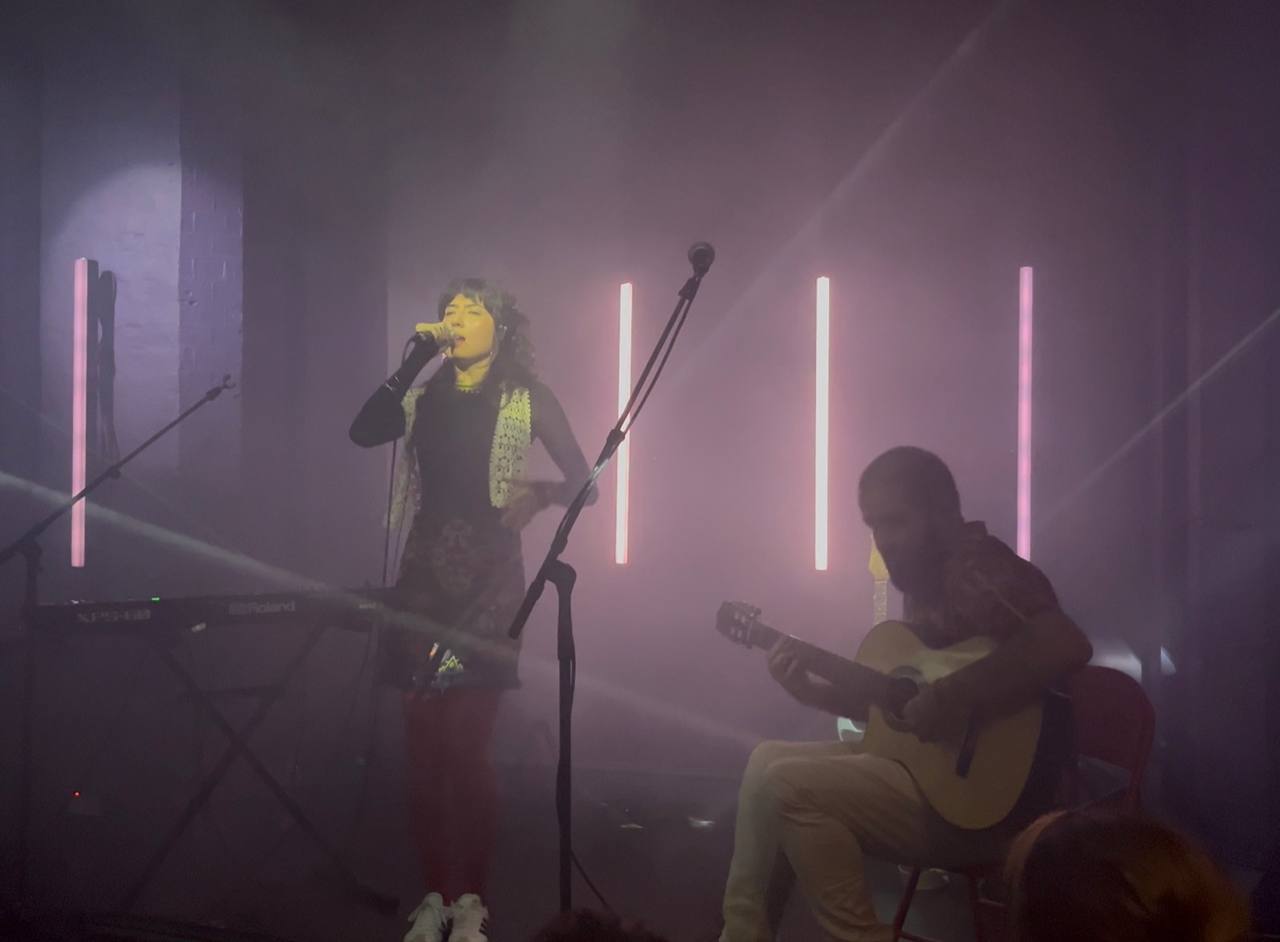
Veiled in smoke and the rays of a spotlight, Mari Merenda enters the stage in a reserved manner. She does not address the crowd at first but is tiptoeing around her Roland XPS-60 keyboard, checking that all the cables are in the right order.
While the setup is underway, the crowd quitely whispers her name as she briefly converses in Portuguese with a member of her band.
By this point, you have to realise that Merenda’s gigs are not about raucous entrances. They are brimming with serenity far from any disruptions. That is the primary means of transmission of her music, which is aimed at feeling present and brings everyone together.
The crowd is taken back to 1994 as Minha Massao saturates the space. Even though it isn’t her original composition, her rendition of João Nogueira & Paulo César Pinheiro’s song has a tribal quality, with the pre-recorded percussion layering beneath her almost chant-like singing.
This theme revolves around the multitude of rays radiating sporadically as a beacon aimed at the two performers, accompanied by nine linear lamps uniformly aligned throughout the background. A sound that was supposed to have grown increasingly acoustic evokes a sense of ancient ritualistic tradition.
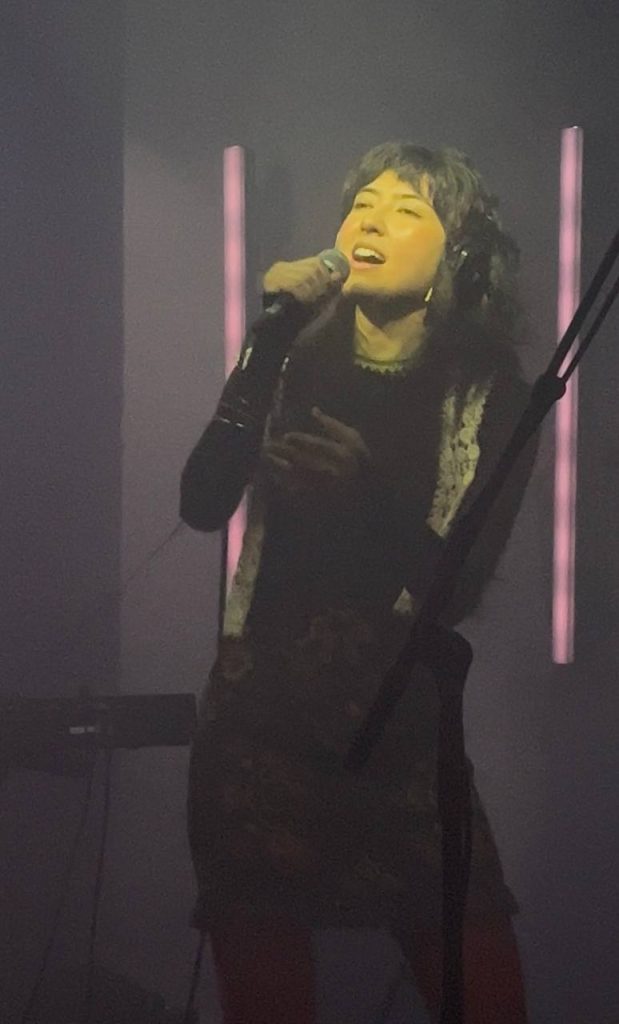
Almost dancefloor-adjacent, Furia leaves you with goosebumps running up your neck. The shift in sound to an electric guitar rises up as a distant storm. String chords of the keyboard add fragility to the celestial realm of abstraction.
Her singing takes an unexpected turn to vibrance, with a tempo worthy of an electronic pop remix. Merenda has always been experimental in her music production process, and the timing is right. Furia, best summed up in one word as an anthem to folkloric pop, has the potential to become one of Brazil’s hopeful anthems as elections loom. The density of the bass is lacking. The delivery? It is as present as ever.
The moment the keys hand off Merenda’s hands to Asalato feels both enrapturing and thrilling. Emotionally aware of her audience, Merenda subtly changes gears to an inexorable passing of time.
Summoning her confident and expressive presence, she looks intently at the West African instrument that earned her recognition. Two songs in, she keeps her opening act Borges Machado, an experimental duo working with Brazilian music, improvisation, and field recordings, in mind and invites them to celebrate the sound of the Amazonian folk song Uirapuru, followed by Bote No Lugar a few songs later.
“Travelling across the ocean from Brazil to be here; to know that there are people who listen to my music…this is so special,” Merenda says, while also being grateful to all who have made it to her show.
A round of applause ensues, followed by Rodopiado (Veneno) singing in unison while Latin dancing fills the space before the stage. Understandably so, as it can be perceived as a token of gratitude for everything that Brazilian folk-pop and MPB represent: music bound to get you clapping in unison.
Catch Mari Merenda live in London this Sunday at The Jago.